 0
Concepts
1
Boutique
2
Fabrique
3
Clinique
4
Portique
5
Deconstructions
6
Détournements
7
Art
8
Philosophy
9
Science
Tractatus Deconstructed
0
Concepts
1
Boutique
2
Fabrique
3
Clinique
4
Portique
5
Deconstructions
6
Détournements
7
Art
8
Philosophy
9
Science
Tractatus Deconstructed
A celebration of Wittgenstein's Tractatus Logico-Philosophicus
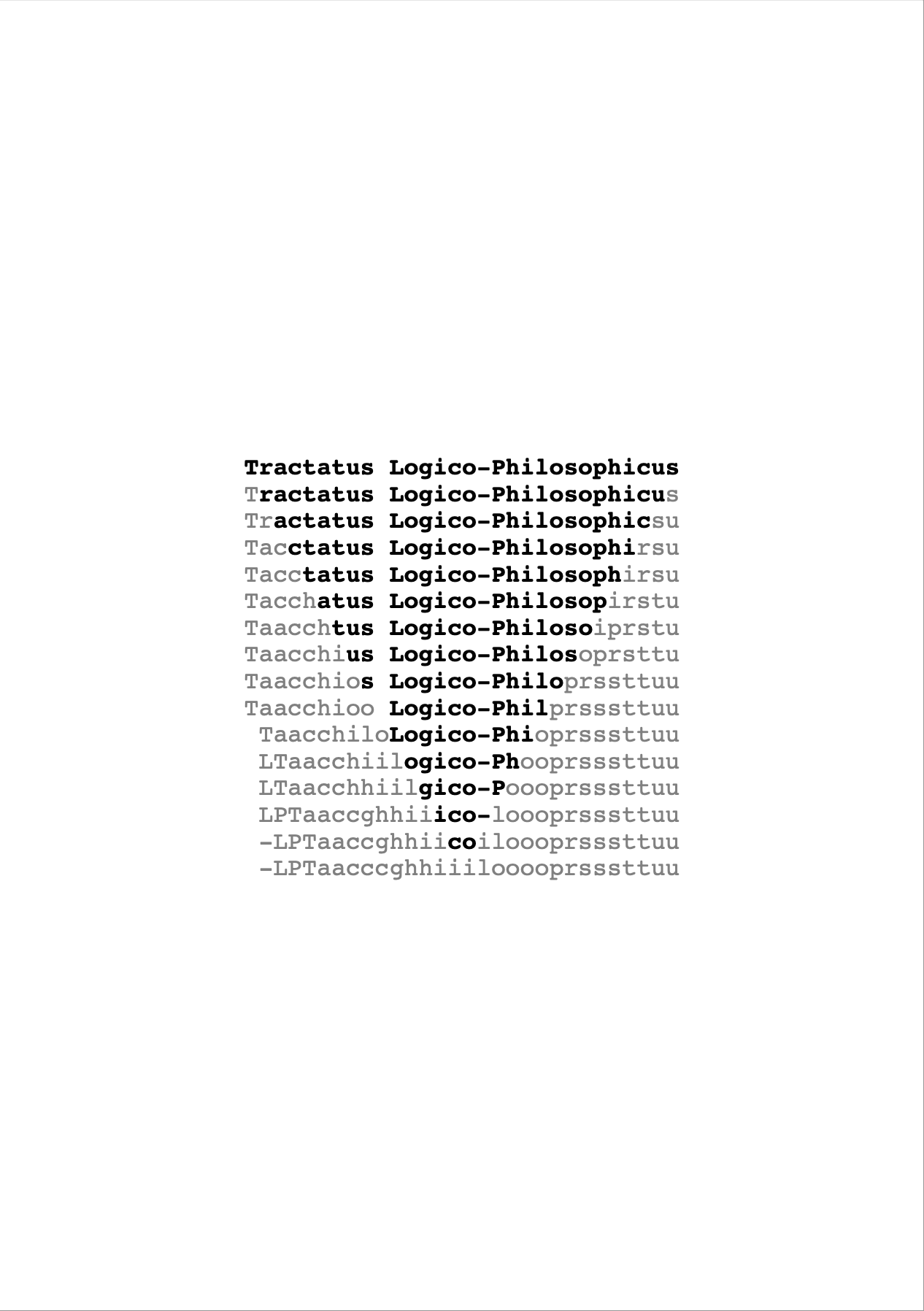
Some example (double) pages below:


 concept 4
by Peter Manuel
Ludwig Wittgenstein's Tractatus Logico-Philosophicus is generally considered one of the most significant philosophical works of the twentieth century. The 'Tractatus' is a hard book to read: it is abstract and succinct, and does not explain its supposedly self-evident statements. It tries to show in a formal, logical way that language is fundamentally limited when describing reality. For instance, many philosophical questions are mere fabrications of language, they have no meaning in reality. Wovon man nicht sprechen kann, darüber muß man schweigen. Freed from confusion, one can focus on what really matters: relationships, music, nature, etcetera.
Wittgenstein was aware that the Tractatus suffers the same fate as other philosophical attempts to describe reality. At the end of the book, Wittgenstein describes the Tractatus as a ladder that one should throw away after climbing it.
Since Wittgenstein states that the Tractatus has no real meaning (Tractatus, proposition 6.54), this leaves the actual text as a collection of letters, numbers and punctuation marks.
Tractatus Deconstructed takes all these elementary syntactical elements, and sorts them in the order prescribed by the Unicode standard. No character of the 1922 German version of the Tractatus has been left out. The book starts with the only exclamation mark found in the book. It ends with the graphical parts of the formulas included in the original.
When you have read the Tractatus, replace it by Tractatus Deconstructed. A keepsake of the climb up the ladder that took you to Wittgenstein's scenic viewpoint.
First edition, limited to 42 copies | 'the white album' | paperback | 179 pages | € 150
Second edition | 'the black album' | paperback | 179 pages | € 30
Available in the boutique.